
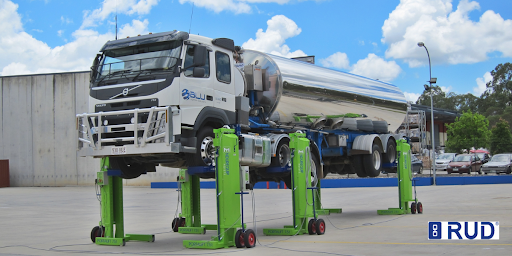
Heavy vehicle hoists lift trucks, buses, and large machinery so mechanics can safely access the underside. They remove the need to crawl under vehicles supported by jacks or blocks, which can be dangerous and slow.
This is why you need to be careful in choosing the right hoist. If you pick one that is too powerful, you may overspend. And if it can’t handle your equipment, it’ll slow down your work and create safety risks.
At RUD, we’ve spent over 140 years engineering lifting and material handling equipment across Australia, including the Endurequip Portalift we manufacture right here in Brisbane.
We’ve seen how choosing the wrong hoist can slow down a workshop, put teams at risk, and lead to ongoing repair costs and downtime. But many buyers feel overwhelmed by all the different types, load ratings, and confusing specs out there.
That’s why we put together this guide. We’ll walk you through what heavy vehicle hoists are built for, and when a chain hoist or electric hoist might suit your setup better. Let’s start by reviewing the types of heavy vehicle hoists and which fits your needs best.
Types of Heavy Vehicle Hoists: Which One Fits Your Workshop?
The right hoist depends on your vehicle size, floor space, and whether you need to move the equipment around. Some workshops, for example, do better with a fixed setup for heavy trucks, while others need portable options that move between bays.
Here’s a breakdown of the main hoist types so you can find the best fit for your workshop.
2-Post and 4-Post Hoists
2-post hoists lift a vehicle by the chassis (or its main frame), which gives mechanics easy access underneath. On the other hand, 4-post hoists are lifted by the wheels, which makes the vehicle more stable.
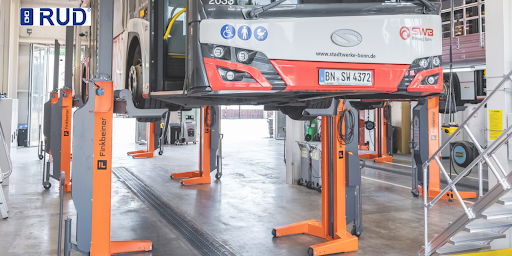
Either way, these are the most common setups in automotive workshops across Australia, and for good reason. They handle general vehicle service well, including passenger cars and light trucks.
However, these hoists need a strong foundation to operate safely. Which is why most manufacturers recommend reinforced concrete that is 100 to 150 mm thick, with a minimum strength of 25 MPa. You’ll also need adequate ceiling clearance, usually around 3 to 4 metres, depending on the model.
Now, the upside is they’ll offer strong, stable lifting with a familiar setup most mechanics already know. But once you install them, they’ll stay in place, which limits flexibility if your workflow changes later.
Mobile Column Hoists
Fleet operators and heavy vehicle workshops often choose mobile column hoists instead for their versatility. These are individual lifting units that you can move and place under each wheel of a vehicle.
This makes it easy to lift trucks, buses, and mining equipment, with capacities from 6.5 to 17.5 tonnes per column, depending on the model. For extremely heavy loads, you can connect up to 32 columns to handle the weight safely.
Your main advantage here is flexibility. So if your workshops have mixed fleets, like trucks, buses, and vans, you get the most value because you can move the hoists between bays as needed.
They also work on most flat surfaces without permanent floor anchors, which makes them a practical choice for multi-bay operations.
Scissor and Platform Lifts
Scissor lifts and platform hoists are built for wide vehicles, trailers, and heavy machinery. The two types work differently: scissor lifts use a crisscross metal frame to raise the vehicle, while platform hoists lift it on a flat surface.
Some of their models can mount flush into the floor, which keeps your workshop clear when the lift sits idle. This setup suits facilities that need to squeeze the most out of their floor space.
That said, think about the footprint and installation time before you commit. Flush-mounted scissor lifts require cutting into your concrete slab, and that adds complexity and cost compared to surface-mounted options.
Don’t Forget the Layout
Before you order a hoist, measure your workshop, check your power supply, and plan how vehicles will move through the space. Even a hoist that seems perfect on paper can cause problems if it blocks traffic or sits too close to walls.
Integration is important too when installing hoists. Fixed hoists need floor anchors drilled into reinforced concrete, and you’ll need dedicated power lines run to each unit.
Taking care of these details before installation will make the process much smoother.
Manual vs. Electric Garage Door Hoists: What You Need to Know
The mechanism you choose affects how fast you can lift, how much effort your team puts in, and how often the equipment needs servicing. For example, manual chain hoists are best for lighter, less frequent jobs, while electric chain hoists handle heavier loads with less physical strain.
Let’s find out which hoist suits your workshop.
When to Choose a Manual Chain Hoist
Manual chain hoists are a good choice for workshops that don’t lift heavy loads all day. These hand-operated devices use a chain to lift or lower heavy objects, so they don’t need electricity. They are also simple to set up and cost-effective. Because of this, they work well in rural workshops, mobile rigs, or remote sites where power isn’t always available.
The trade-off is how fast and easily it is to lift a load. You’ll need to pull the hand chain yourself, and that takes more energy and time than a powered unit would.
The Case for Electric Chain Hoists
If your workshop lifts heavy items on a regular basis, an electric chain hoist is worth the investment. These units move heavier loads faster and take the physical strain off your team. The motor does the hard work, so operators can stand back and guide the load with a pendant control instead.
Plenty of workshops across Australia use electric hoists alongside vehicle hoists for jobs like engine removal or gearbox swaps. It’s especially helpful when you lift engines or gearboxes multiple times a day.
Safety, Maintenance, and ROI
One of the biggest advantages of electric chain hoists is the safety features they come with. Most models include overload protection, automatic brakes, and limit switches that stop the hoist if it goes beyond safe travel limits. These systems prevent operators from lifting more than the hoist can handle and keep the load secure if the power cuts out.
There’s also less chance of fatigue-related injuries, like sore shoulders, strained arms, and back pain, because your team isn’t pulling chains by hand all day.
And when you look at lifecycle costs, a cheaper manual hoist might seem like a bargain at first. But higher labour time and injury risks can end up costing more over the long run.
Compliance and Support in Australia
Now, before you buy any hoist, make sure it meets the relevant Australian Standards. For vehicle hoists, that’s AS/NZS 2550.9, which covers the safe use requirements. For serial hoists and winches, AS 2550.1 is the standard to check.
Buying from a local supplier can also help when it comes to ongoing support. If something breaks down, a supplier with stock in Melbourne or Brisbane can get parts to you faster. That will keep your workshop running and cut down on costly downtime.
Choose the Right Workshop Hoist for Safety and Efficiency
So, did any of these hoist options catch your eye?
Getting the right hoist can change the way your workshop runs. It’ll improve safety, speed up your workflow, and protect your investment over time. But heavy vehicle hoists and electric chain hoists aren’t one-size-fits-all. The best pick will come down to what you’re lifting, how much space you have, and how often you’ll use it.
So take a fresh look at your current workshop lifting setup. Then compare it with the options we’ve covered here. If something only “sort of works,” chances are it’s costing you time, money, or both.
When you’re ready to upgrade, RUD Australia can help. We supply hoists, lifting chains, and material handling gear built for Australian conditions.
Reach out to our team, and we’ll help you find the right fit.